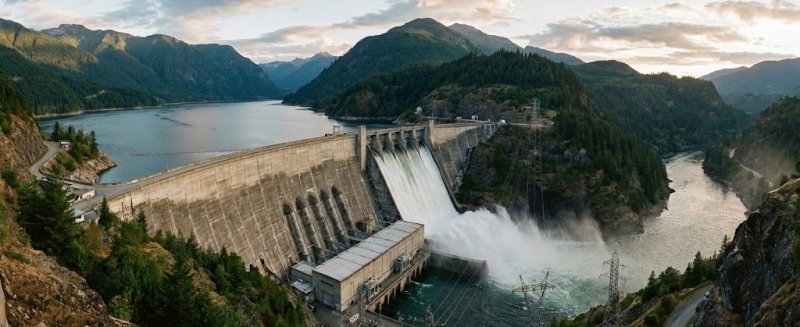
Before construction begins, engineers perform extensive hydrological assessments, including long-term river flow analysis, precipitation models, reservoir capacity studies and sedimentation forecasts. Geological surveys examine rock formations, soil stability, seismic risks and foundation suitability. These studies determine the ideal dam height, turbine type, operational flow regime and long-term sustainability of the project.
A hydroelectric power plant consists of several critical structures:• Dam: Stores water and regulates downstream flow.• Spillway: Safely releases excess water during floods.• Penstock: High-pressure conduit that delivers water to the turbines.• Turbine Hall: Houses mechanical turbines and generators.• Switchyard and Transformer Units: Increase voltage for transmission.Turbine selection—Francis for medium head, Kaplan for low head and Pelton for high head applications—is based on hydraulic characteristics. CFD simulations, efficiency curves, cavitation resistance and load distribution analyses guide final design.
Construction includes massive concrete dam works, excavation of water channels, installation of steel-lined penstocks, turbine-generator assembly and vibration-resistant foundation systems. Mechanical installation requires precise alignment of turbine runners, wicket gates, shafts and bearings to ensure minimal mechanical loss and long-term durability. Welding quality, corrosion-resistant coatings and sealing systems are tested under extreme conditions.
Electrical systems include step-up transformers, breakers, switchgear, excitation systems and protection relays. Digital SCADA platforms monitor real-time voltage, rotor speed, power factor, reservoir level, temperature and vibration data. Operators use automated gates and predictive algorithms to maximize power output while maintaining grid stability.
Hydropower plants operate with high efficiency, often exceeding 90%. Flow control, turbine maintenance, sediment flushing and cavitation mitigation ensure sustained performance. Environmental considerations include fish passage systems, controlled water release schedules, erosion prevention and biodiversity protection programs.
Preventive maintenance includes turbine inspections, lubrication cycles, bearing condition monitoring, cleaning of intake screens and periodic generator rewind operations. Digital twins and AI-based monitoring enhance predictive maintenance strategies, extending equipment lifetime and preventing costly downtime.